

TL;DR:
- Streaming rights are permissions from copyright holders that specify where, when, and on which platforms content can be broadcast legally. These rights are territorial, time-limited, and often exclusive, requiring creators to manage negotiations carefully to avoid infringing or content removal. Proper rights management and metadata tracking are essential for compliant and successful online streaming.
If you stream content online, understanding what are streaming rights is not optional. It is the difference between operating legally and facing a takedown or legal action. Streaming rights are permissions that define who can distribute content, where, on which platform, and for how long. Most creators assume these rights are automatic or global. They are not. Rights are territorial, time-limited, and often exclusive to specific platforms, which means the rules for your stream depend heavily on what you are broadcasting and to whom.
Table of Contents
- Key takeaways
- What are streaming rights and how they work
- How streaming rights contracts are structured and enforced
- Types of streaming rights and what they mean for creators
- Common challenges creators face with streaming rights
- How to manage and negotiate streaming rights effectively
- My take on streaming rights and the future of creator distribution
- Start streaming with confidence on Vexiotv
- FAQ
Key takeaways
| Point | Details |
|---|---|
| Rights are territorial and time-limited | Streaming rights are licensed by region and expire, so content availability shifts over time and across countries. |
| Exclusivity changes who can stream | Exclusive contracts restrict content to one platform per territory; non-exclusive deals allow multiple services simultaneously. |
| Owning content is not enough | Purchasing or owning a video does not automatically grant public performance or streaming rights for distribution. |
| Live streaming has extra rights layers | Broadcasting third-party content live triggers multiple rights requirements, including public performance and audiovisual use permissions. |
| Rights metadata prevents compliance failures | Tracking rights expiration and territorial scope as metadata is the most reliable way to avoid accidental infringement. |
What are streaming rights and how they work
Streaming rights are legal permissions granted by a copyright holder that allow a party to transmit or broadcast content over the internet to an audience. They sit within the broader framework of copyright law but are a distinct type of license. Buying a DVD, downloading a file, or even owning the copyright to a piece of music does not automatically give you streaming rights. Those are separate, negotiated permissions.
The territorial nature of streaming rights is one of the most misunderstood aspects. Platforms negotiate regional agreements rather than single global licenses, which is why a show available in the United States may be unavailable in Germany on the same service. Rights holders sell or license content market by market, each deal with its own terms. This is why viewers and creators experience what researchers call "rights gaps," where content simply disappears or appears unavailable. It is not a technical error. It is a rights boundary.
Here is what territorial and contractual streaming rights typically cover:
- Territory: The specific country or region where streaming is permitted
- Duration: The start and end dates of the license window
- Platform: Which service or channel is authorized to stream
- Exclusivity: Whether only one platform may stream the content or multiple can
- Monetization model: Whether the content can be used in subscription, pay-per-view, or ad-supported formats
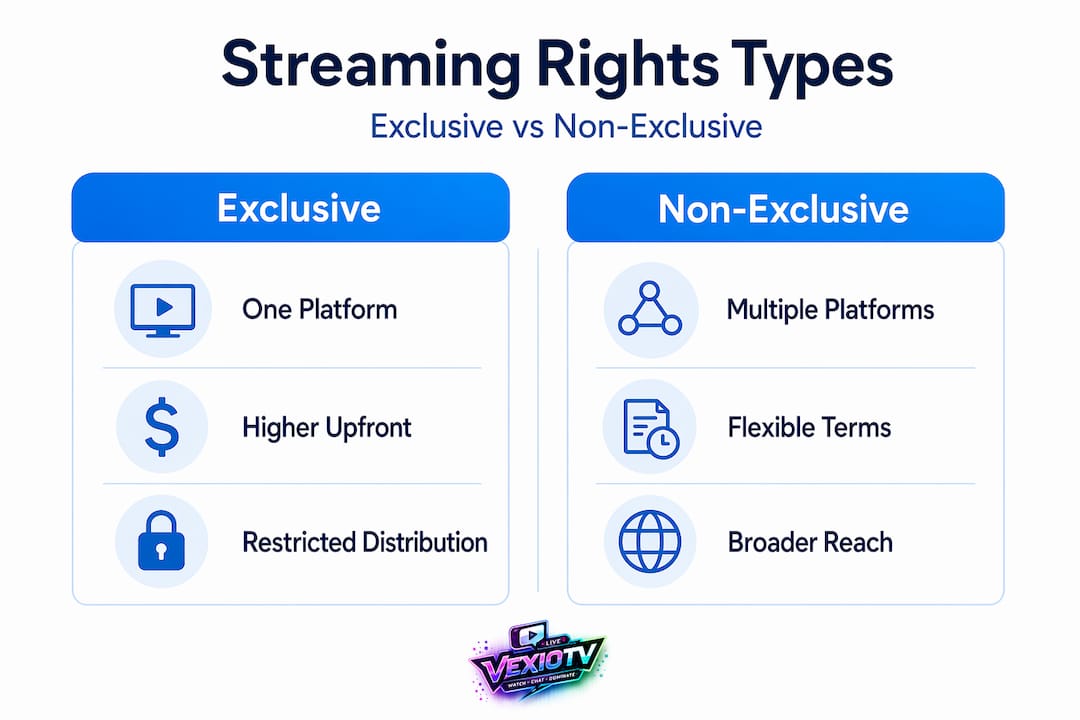
Exclusive contracts mean only one service can stream within a territory during the agreement period. Non-exclusive contracts allow the same content to appear on multiple platforms at the same time. Both models are common, and the distinction matters enormously for creators deciding where to distribute their work.
How streaming rights contracts are structured and enforced
Contracts for streaming rights are not simple documents. They specify territory, duration, allowed platforms, exclusivity status, and monetization format. Every one of those variables requires a technical system on the back end to enforce it in real time. That system is called a rights management system.
Rights management systems translate contract terms into operational rules. When you try to watch content that is unavailable in your region, a geographic IP check has already matched your location against the rights data and blocked access. The same logic applies to device restrictions, where some contracts limit playback to specific hardware, and to time windows, where content is automatically activated or deactivated based on the license start and end dates.
Here is how technical enforcement typically works, step by step:
- The rights management system receives the contract terms as structured metadata.
- Geographic IP verification matches the viewer's location against permitted territories.
- Account and device controls check whether the platform type and user tier are authorized.
- The system activates or deactivates content automatically when the license window opens or closes.
- DRM then secures the actual playback stream against unauthorized copying or redistribution.
Pro Tip: DRM and rights management are not the same thing. DRM protects the content file from being copied. Rights management controls whether a viewer is entitled to watch at all, based on contract terms. Both are needed, but they serve different functions.
| Layer | Function | Example |
|---|---|---|
| Rights management | Enforces contractual entitlement | Blocks U.S. viewers from EU-only licensed content |
| DRM | Secures the content file | Prevents downloading or screen recording |
| Geo-restriction | Verifies viewer location | IP check against permitted territories |
| Time windowing | Activates or deactivates by date | Content removed automatically at contract end |
Types of streaming rights and what they mean for creators
Not all streaming rights are the same. The type of content you are broadcasting, the way you are monetizing it, and whether you are streaming live or on demand all determine which permissions you need.

Live streaming vs. on-demand content carry different rights requirements. On-demand content is licensed in advance as a fixed asset. Live streaming is more complex because third-party content in a live broadcast triggers multiple rights layers simultaneously, including public performance rights and audiovisual use rights, both of which require separate clearance.
Music is the most common area where creators run into trouble. Streaming music publicly is treated as a public performance, not a private playback. Platforms like Spotify secure blanket licenses from performance rights organizations at the service level. That means their users are covered. But if you are a creator streaming music on a platform that has not cleared those licenses, or if you are playing music during a live stream on a platform that only covers certain use cases, you are responsible for obtaining the appropriate permission yourself.
Monetization format also drives rights requirements:
- SVOD (subscription video on demand): Rights must specifically authorize subscription-based access; a license for pay-per-view does not cover subscription use.
- TVOD (transactional video on demand): Requires separate clearance for individual purchase or rental transactions.
- Ad-supported streaming: Some rights agreements prohibit advertising against specific content, so ad placement must be confirmed in the contract.
Pro Tip: Owning or purchasing a video does not grant public performance or streaming rights. Those permissions must be obtained directly from the copyright holder before you broadcast to any audience, regardless of how large or small.
Common challenges creators face with streaming rights
Rights issues surface in ways that catch most creators off guard. Content gets removed without notice. Live streams get muted or flagged mid-broadcast. Ad revenue disappears because an expired rights window disqualified the content from monetization.
Rights expiration is a frequent operational problem. When a license window closes, content should be deactivated automatically. But if the rights metadata is incomplete or the management system fails to update, the content either stays live beyond its permitted window or disappears unexpectedly, leaving viewers with broken experiences and creators with compliance problems.
"Viewers and creators experience 'rights gaps' as missing content or removals due to territorial and temporal rights limits, not technical failures." — How Streaming Rights Work Explained Simply
The table below compares two common contract structures and their operational effects:
| Factor | Exclusive deal | Non-exclusive deal |
|---|---|---|
| Platform access | One platform only, per territory | Multiple platforms allowed |
| Audience reach | Restricted to one service's user base | Broader potential audience |
| Licensing revenue | Typically higher per deal | Lower per deal, but stackable |
| Creator flexibility | Limited during contract term | More distribution options |
| Risk of removal | High if deal lapses | Lower, can shift between platforms |
Exclusive deals pay more upfront but lock your content to a single distribution channel. Non-exclusive deals give you flexibility but generally offer less revenue per agreement. The right choice depends on your content's value and your long-term distribution goals.
How to manage and negotiate streaming rights effectively
Understanding the structure is one thing. Putting it into practice is another. Here is a step-by-step approach for creators managing rights before and during a streaming deal:
- Build a rights checklist before going live. Identify every piece of third-party content in your stream, including music, video clips, and graphics. Confirm whether each element is cleared for public performance and streaming use.
- Specify contract terms precisely. Generic licensing without detail leads to disputes as content shifts platforms or monetization models. Your contract should state territory, start and end dates, exclusivity status, and the specific monetization formats permitted.
- Confirm platform-level rights coverage. Ask the platform directly which rights they have cleared at the service level, particularly for music. Do not assume coverage.
- Track your rights as metadata. Log every license you hold, including territory, duration, and scope, in a structured format. This prevents compliance failures when windows expire. Rights expiration tracking is the most reliable defense against accidental infringement.
- Plan for renewal well in advance. Rights windows close on fixed dates. Build renewal or replacement steps into your content calendar at least 60 days before expiration.
Pro Tip: When negotiating, always ask whether the license covers your specific monetization model. A contract that authorizes ad-supported streaming does not automatically cover subscription or pay-per-view use. Confirm each format explicitly in writing.
Understanding how streaming monetization models interact with rights contracts can save you from building a revenue strategy on a foundation that your license does not actually support.
My take on streaming rights and the future of creator distribution
I've been watching how creators engage with rights, and the pattern is consistent. Most people treat streaming rights as a legal formality to deal with later. They focus on content, community, and monetization first, and assume rights issues are someone else's problem until they are not.
In my experience, the creators who scale reliably are the ones who treat rights as a core part of their production workflow, not an afterthought. The complexity is real. Rights management shapes content discovery, pricing, and global expansion in ways that go far beyond simple compliance. A poorly structured license can lock you out of new platforms or markets entirely.
What I've found actually matters is specificity. Vague contracts create vague outcomes. Every term you leave undefined in a rights agreement becomes a point of friction later. The creators who understand the difference between what they own and what they are licensed to do publicly are the ones who avoid the expensive mistakes.
The future is moving toward rights automation and global licensing frameworks, but that shift is not here yet. For now, the responsibility sits with you as the creator. Engage with rights proactively. Understand the scope of every license you hold. That knowledge is not just legal protection. It directly determines how far your content can travel.
— M7
Start streaming with confidence on Vexiotv
Knowing what streaming rights are is the first step. The next step is choosing a platform built with creators in mind. Vexiotv is a live streaming platform focused on creator monetization, community building, and straightforward content control. Whether you stream gaming, music, or live events, Vexiotv gives you a clear space to go live and earn from your content. Understanding platform growth and rights becomes much more practical when your platform is built for creators rather than against them. Sign up at Vexiotv and go live on your terms.
FAQ
What are streaming rights in simple terms?
Streaming rights are legal permissions that allow a party to transmit content over the internet to an audience. They are separate from ownership and must be obtained from the copyright holder.
Why does streaming content vary by country?
Territorial licensing means platforms negotiate rights region by region. Content available in one country may not be licensed for another, causing differences in library availability across platforms.
Do I need streaming rights for live streaming?
Yes. Live streaming third-party content triggers public performance and audiovisual use rights requirements. Clearance must be confirmed before you broadcast, not after.
What is the difference between exclusive and non-exclusive streaming rights?
Exclusive rights mean only one platform can stream the content in a given territory during the contract period. Non-exclusive rights allow multiple platforms to stream the same content simultaneously.
How do I avoid streaming rights violations as a creator?
Build a rights checklist for all third-party content, specify every contract term in writing, confirm platform-level coverage directly, and track rights expiration as structured metadata to stay compliant.