
TL;DR:
- Social streaming centers on real-time audience interaction, transforming viewers into active participants.
- Engaged communities drive higher retention, immediate feedback, and increased monetization opportunities.
- Success relies on authentic engagement, consistent rituals, and building familiarity over perfect production.
Live streaming has exploded in recent years, but many creators and gamers still treat it as a one-way broadcast. Social streaming is different. It puts real-time audience interaction at the center of every session, turning passive viewers into active participants. Platforms built around this model have changed how creators grow, earn, and connect. This guide breaks down what social streaming is, how it compares to traditional options, why it matters for your growth, and what steps you can take to get started and build something lasting.
Table of Contents
- What is social streaming and how does it work?
- Social streaming vs. traditional streaming: A comparison
- Why social streaming matters for content creators and gamers
- Best practices to succeed with social streaming
- What most people miss about social streaming
- Ready to grow your streaming community?
- Frequently asked questions
Key Takeaways
| Point | Details |
|---|---|
| Social streaming defined | Social streaming combines live content with real-time community engagement for richer experiences. |
| Interactivity is key | Audience input through chat and features shapes each broadcast and drives growth. |
| Community drives success | Creators who focus on engagement and feedback often see greater loyalty and monetization. |
| Starter tips matter | Simple best practices and the right habits help streamers break through and succeed. |
What is social streaming and how does it work?
Social streaming means going live with built-in community interaction as a core feature, not an afterthought. The audience does not just watch. They type in chat, vote in polls, trigger on-screen reactions, and influence what happens next. That back-and-forth is what separates social streaming from simple broadcasting.
As noted in research on community-driven streaming, social streaming is about real-time community interaction where audience feedback shapes the experience. That definition captures the key point: the stream is a shared event, not a performance.
Platforms built around this model include Twitch, YouTube Live, Facebook Gaming, and newer options like VexioTV. Each offers tools designed to keep viewers engaged and connected. Understanding why streaming is popular helps explain why these platforms have grown so fast.
Here is how social streaming differs from traditional broadcasting at the feature level:
| Feature | Social streaming | Traditional broadcasting |
|---|---|---|
| Audience interaction | Real-time chat, polls, reactions | Minimal or none |
| Content permanence | VODs plus live replays | Archived episodes |
| Monetization | Donations, subs, channel points | Ad revenue only |
| Community tools | Emotes, moderation, redeems | Not typically available |
| Platform examples | Twitch, YouTube Live, VexioTV | Netflix, linear TV |
Key features you will find on most social streaming platforms:
- Chat moderation tools to keep conversations positive
- Emotes and custom reactions tied to your channel
- Channel points that viewers earn by watching and spend on redeems
- Real-time polls to let the audience vote on what happens next
- Alerts and notifications for new follows, subs, and donations
"The community dynamic isn't a side effect. It's the main product."
If you want to go deeper on the creative side of this, creative live streaming covers how interaction fuels both engagement and income.
Social streaming vs. traditional streaming: A comparison
Now that the definition is clear, it helps to see how social streaming stacks up against classic non-interactive streaming. The differences go beyond chat boxes.
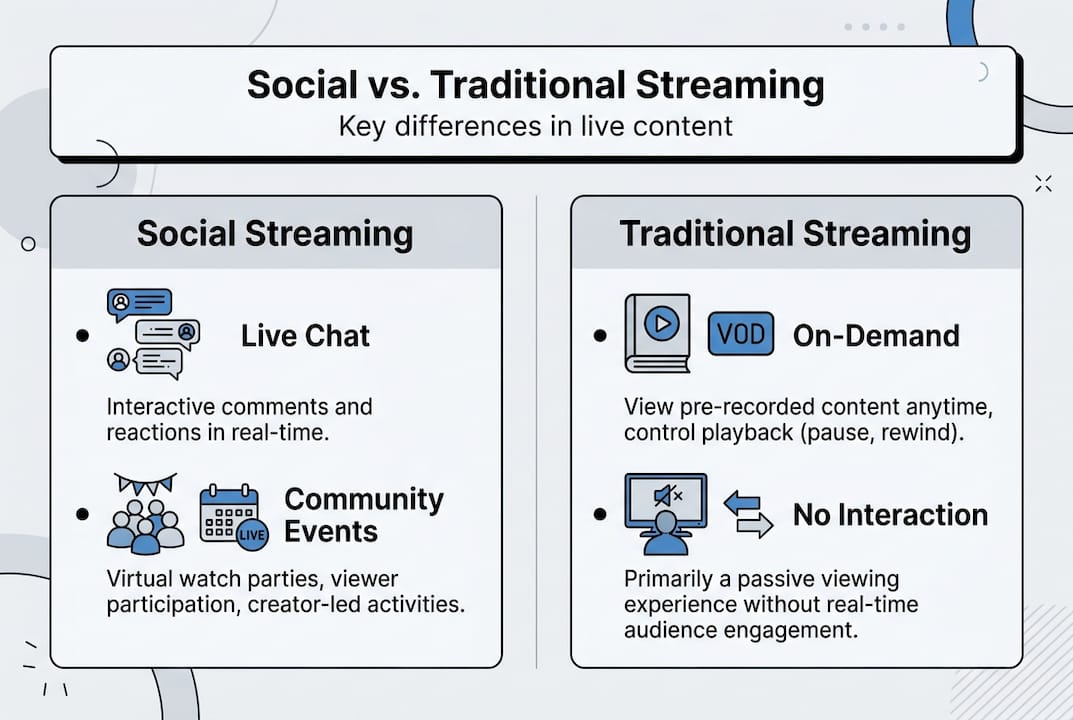
Traditional streaming services like Netflix or pre-recorded YouTube uploads are built around algorithms and post-event viewership. You upload content, the platform serves it to users based on search or recommendations, and you track views over time. Discoverability and feedback loops are core differences: social platforms are optimized for real-time participation, while traditional video streaming leans on search and algorithms for viewership after the fact.
| Category | Social streaming | Traditional streaming |
|---|---|---|
| Discoverability | Live feed, community sharing | Search and algorithm |
| Viewer interaction | Real-time, two-way | One-way, passive |
| Content lifespan | Short peak, archived after | Long-term evergreen |
| Community building | Built into the platform | External, if at all |
| Creator feedback | Immediate, during stream | Delayed, via comments |
The practical impact of this difference is significant. Social streaming platforms push you toward consistent scheduling and audience rituals. Your live streaming communities grow because viewers return for the experience, not just the content.
Here is what social streaming's real-time tools actually give creators:
- Immediate feedback on what works and what doesn't, during the stream
- Direct revenue from viewers who donate or subscribe in the moment
- Higher retention because engaged viewers stay longer
- Organic growth as viewers share clips and moments across social media
- Brand partnerships that become easier to secure with an active, loyal community
Studies show that creators on interactive platforms report significantly higher engagement rates compared to those relying solely on traditional video uploads. The gap is not small. Community participation drives both the metrics and the income in ways passive viewership simply cannot replicate.
Why social streaming matters for content creators and gamers
For growth-minded creators and gamers, social streaming is not optional anymore. It is the primary driver of audience loyalty and direct income. Understanding the benefits makes it easier to prioritize where you spend your time.
The broadcasting model alone no longer defines creator success. Community engagement does. Here is a breakdown of the core benefits:
- Audience loyalty: Regular viewers become invested community members, not just casual fans
- Live donations and subscriptions: Direct financial support from the people watching in real time
- Community feedback: Instant input on content direction, game choices, and stream format
- Brand partnerships: Sponsors want engaged audiences, and social streaming delivers that clearly
- Cross-platform growth: Clip-worthy moments from live sessions spread across YouTube, TikTok, and Reddit
For gamers specifically, streaming transformed gaming culture by turning solo play into a shared event. The most successful gaming streams feature constant chat interaction, viewer-driven in-game challenges, and community memes that build over weeks and months.
There is also a financial angle that matters. Learning about community, reach, and revenue shows that monetization on social platforms scales directly with how active and loyal your community is.
Pro Tip: Do not treat your audience as background noise. Ask questions during the stream, respond to chat by name, and create recurring segment names your community will recognize. Active engagement is the biggest differentiator between channels that plateau and channels that grow.
"In 2026, community participation isn't optional. It's the foundation for creator sustainability and income."
This context should shape how you plan and build your channel from day one.
Best practices to succeed with social streaming
With the value clear, here is how to put it all into practice. These steps apply whether you are starting from zero or refining an existing channel.
-
Pick the right platform. Match your content type to the platform's audience. Gaming content thrives on Twitch and VexioTV. Music and creative content has room to grow on newer platforms focused on monetization and community.
-
Set up your creator tools. You need a decent microphone, a webcam, and basic streaming software like OBS. Overlays, alerts, and on-screen graphics improve the viewer experience. Start simple and add complexity over time.
-
Use engagement triggers consistently. Ask questions out loud. Run polls. Set up channel point redeems that viewers can activate. Interactive features like chat highlights and on-screen reactions can dramatically boost engagement and keep viewers coming back.
-
Moderate chat for positivity. A toxic chat drives away new viewers. Use bots and trusted moderators to keep conversations constructive. A safe chat environment is a growth tool.
-
Promote outside the platform. Post your schedule on Twitter, TikTok, and Discord. Share clips after each session. Build awareness so new viewers find you before they ever land on your channel page.
An interactive stream setup does not require expensive gear. A consistent presence and strong community rituals matter far more than production value in the early stages.
Pro Tip: Review your stream analytics after every session. Look at viewer drop-off points, peak concurrent numbers, and chat activity spikes. These data points tell you exactly what your audience wants more of.
Review your data regularly. Pilot community challenges, viewer tournaments, or reward systems tied to your channel points. The streams that grow fastest treat each session as a test run for what works next time.
What most people miss about social streaming
Most guides cover tools and platform features. Few address the underlying reality that shapes long-term success.
Your audience shapes the stream as much as you do. That sounds simple, but most new creators still approach social streaming with a broadcaster mindset. They plan every moment, script interactions, and try to optimize for discoverability above all else. That approach misses the point.
Over-optimizing for algorithms risks losing the core value of live streaming communities: genuine, unscripted moments where viewers feel like participants. The inside jokes, the running bits, the community nicknames—these are not side effects. They are the product.
Flashy overlays and perfect camera setups do not create loyalty. Recognizing your regular viewers by name does. Letting chat influence a decision in real time does. Building rituals that repeat week after week does.
"Authenticity and mutual recognition turn passive viewers into lifelong fans."
The most durable streaming channels are built on familiarity, not spectacle. Focus on who is in your chat, not just how many.
Ready to grow your streaming community?
If you are ready to move from watching to doing, the right platform makes the process straightforward.
VexioTV is built for creators who want to go live fast, engage their audience with built-in tools, and start earning from day one. The platform supports gaming, music, IRL content, and creative performances. Monetization options are integrated from the start, so you are not waiting to qualify for a program. Sign up on the VexioTV platform, set up your channel, and go live with one click. Whether you are just starting out or scaling an existing community, VexioTV gives you the tools to build something real.
Frequently asked questions
How is social streaming different from regular live streaming?
Social streaming emphasizes real-time audience interaction and community engagement, while regular live streaming typically focuses on one-way broadcasting. The community engagement is what defines the experience on social platforms.
What platforms are best for social streaming in 2026?
Twitch, YouTube Live, Facebook Gaming, and VexioTV are the top platforms in 2026 for interactive community features and built-in monetization tools.
Does social streaming help gamers and creators make money?
Yes. Social streaming enables income through live donations, subscriptions, brand partnerships, and viewer-driven support. Community interaction is the product that enables direct revenue on these platforms.
What equipment do I need to start social streaming?
A computer or phone with a stable internet connection, a webcam, a microphone, and free streaming software like OBS are enough to get started as a beginner.