
TL;DR:
- Building a thriving streaming community requires deliberate onboarding, consistent rituals, and active off-stream engagement. Focusing on behavior-based metrics like repeat viewers and chat participation offers a clearer picture of community health than follower counts. Regularly reinforcing trust, creating predictable routines, and nurturing off-stream spaces foster lasting connections and sustained growth.
Most streamers hit the same wall. Views climb, follower counts move, but the chat stays quiet and nobody comes back next week. Building a streaming community that actually sticks together is a different skill than getting views. It takes intentional onboarding, consistent rituals, and a space for people to connect when you are not live. This guide covers the full process: what to set up before you go live, how to welcome new viewers the right way, how to keep your community active off-stream, and how to measure whether any of it is working.
Table of Contents
- Key takeaways
- Building a streaming community: what to set up first
- Turning first-time viewers into real members
- Creating rituals and engagement that keep people coming back
- Managing your off-stream community hub
- Measuring what actually works
- My take on what actually builds a lasting community
- Start building your community on Vexiotv
- FAQ
Key takeaways
| Point | Details |
|---|---|
| Identity comes first | Define your channel values and niche before focusing on growth tactics. |
| Onboarding converts viewers | A repeatable welcome script and clear first steps turn one-time visitors into regulars. |
| Off-stream hubs matter | Platforms like Discord keep your community active and connected between streams. |
| Rituals build loyalty | Recurring segments create predictability and give members a reason to return. |
| Loyalty metrics beat follower count | Repeat-viewer rate and chat participation reveal real community health. |
Building a streaming community: what to set up first
Before you focus on ways to grow your channel, you need to lay the groundwork. Skipping this step is one of the most common reasons streamers build an audience that never converts into a community.
Start by defining your channel identity. Write down three things your channel stands for and the type of person you want watching. This is not a branding exercise for its own sake. It determines what rules you set, what content you produce, and what behavior you model in chat. Without it, your community has no center to gather around.
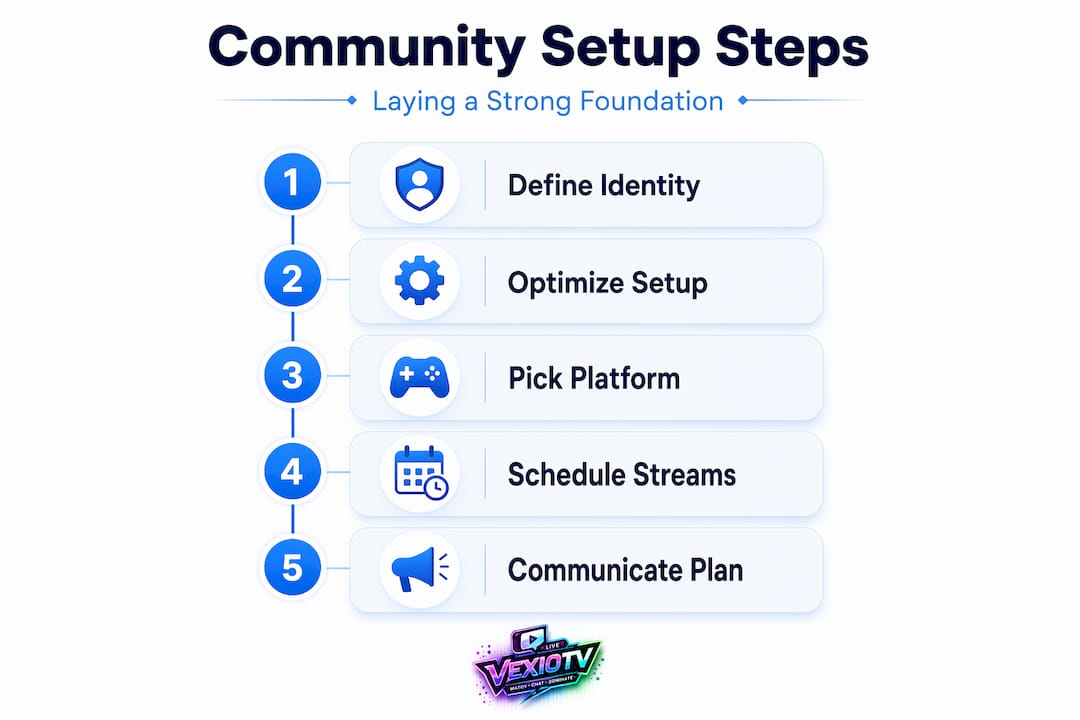
Your technical setup also affects engagement more than most streamers realize. Poor audio, inconsistent video quality, and a cluttered layout push people away before they can connect. Get your basics right: stable stream output, readable chat overlay, and a clear channel description that tells new visitors exactly what they are watching.
Choosing where to build your off-stream community matters just as much. Here is a quick comparison of the most common options:
| Platform | Best for | Onboarding features | Discovery potential |
|---|---|---|---|
| Discord | Deep community building | Welcome Screen, role selection, Membership Screening | Low (invite-only by default) |
| Discussion and content sharing | Subreddit rules, flair, pinned posts | High (public by default) | |
| Facebook Groups | Broader audiences, events | Approval questions, group rules | Medium |
| Vexiotv community | Live-first engagement | Built-in chat, streamer profiles | High (open platform) |
Finally, set a consistent streaming schedule and communicate it clearly. Your viewers need to know when to show up. Post your schedule in your channel bio, pin it in your Discord, and mention it verbally during streams. Predictability is the foundation of why build streaming communities at all: people return when they know what to expect.
Turning first-time viewers into real members
The gap between "someone watched" and "someone joined your community" usually comes down to what happens in the first five minutes. Direct, repeated welcomes convert viewers into members far more effectively than passive streaming.
A repeatable welcome message does several things at once. It acknowledges the new viewer by name, tells them what the stream is about right now, and gives them one clear action to take. That action should be low-friction: follow the channel, type a word in chat, or click the Discord link in the description. Do not ask for a subscription on first contact.
Here is what effective onboarding looks like in practice:
- Verbal welcome: Call out new followers by name during the stream and tell them what is happening.
- Pinned chat message: Keep a short message pinned that explains what the channel is and where to find the Discord.
- Overlay prompt: A simple on-screen graphic with your Discord link or community call to action removes friction for viewers who miss the verbal cue.
- Discord Welcome Screen: Use Discord's built-in Welcome Screen to show new members the most important channels and give them one action to complete first.
Discord onboarding features like Membership Screening and role selection reduce early drop-off by making the first steps clear and simple. Keep your onboarding to three to five steps maximum. More than that and new members abandon the process before finishing.
The data backs this up. Communities see higher retention when newcomers post their first message within 24 hours of joining. Your job is to make that first message as easy and natural as possible. Set up an introduction channel, give members a prompt to respond to, and use a bot to auto-assign a "New Member" role that encourages them to engage.
Pro Tip: Automate your welcome DM on Discord using a bot like MEE6, but personalize the opening line with the member's username. Scaling onboarding quality requires combining automation with personalization to handle volume without frustrating new members.
Creating rituals and engagement that keep people coming back
Loyalty does not come from great content alone. It comes from recurring engagement rituals that give your community something to anticipate and participate in. Think of rituals as the recurring segments that make your stream feel like a show with structure, not just a random broadcast.
Here is a practical approach to building engagement through rituals:
- Pick one weekly segment and name it. A "Friday Fails" highlight reel, a "Monday Q&A," or a "Community Challenge" creates a regular reason to tune in. Naming it matters because it gives members something specific to reference and invite others to.
- Use polls and viewer voting. Let chat decide the next game, the next challenge, or the topic for discussion. Viewer agency increases participation. People stay for outcomes they helped shape.
- Give regulars public recognition. Shoutouts, custom roles, and leaderboard features reward people who show up consistently. This is not just appreciation. It signals to newer members what it looks like to be part of the inner circle.
- Set clear chat guidelines and model them. Post your rules somewhere visible and enforce them consistently. Clear moderation policies with plain language reduce inconsistency and improve overall community health. Ambiguous rules create an environment where regulars feel unsafe and new viewers feel confused.
- Balance access tiers carefully. Subscriber-only content creates motivation to upgrade, but too much gating pushes new viewers away before they are invested. Keep the core experience open and save exclusive perks for your most loyal members.
Use your stream analytics to find out which segments get the most chat activity. Double down on those. Cut or rework segments that consistently produce silence.
Pro Tip: Track your chat participation rate per segment, not just overall. A segment with 60% of your chat active tells you far more than your total viewer count.
Managing your off-stream community hub
Your Discord server is not a bonus feature. It is where your community lives when you are not streaming. Active off-stream spaces are what separate a channel from a genuine community. Research shows 76% of the most engaged viewers log in daily and nearly half attend real-world meetups, which tells you these people want connection beyond the stream itself.

Structure your Discord with clear, simple channel categories. New members should be able to find the introduction channel, the rules channel, and the general chat within thirty seconds of joining. A cluttered server with forty channels and no clear path is one of the fastest ways to lose someone who was ready to engage.
Key practices for a healthy off-stream hub:
- Use bots for routine tasks. Auto-moderation, welcome messages, and role assignment reduce your manual workload. Hybrid moderation combining bots and human review keeps the server safe without creating bottlenecks.
- Run off-stream events. AMAs, game nights, and community watch parties give members a reason to check in on days you are not streaming.
- Create a community leadership tier. Trusted members who help moderate and welcome newcomers take ownership of the space. This scales your presence without requiring you to be online constantly.
- Keep core content public. One mistake many streamers make is gating too much content behind roles or subscriptions early on. Fully gated content blocks discovery. A public server with visible activity attracts new members organically.
The goal is to design your server so that every new member has one obvious first action waiting for them, whether that is choosing a role, posting an introduction, or joining an active discussion thread.
Measuring what actually works
Growing your stream audience with better numbers is straightforward. Measuring whether your community is actually healthy takes different data. Follower count tells you almost nothing about community strength. The metrics that matter are the ones tied to behavior.
| Metric | What it measures | Benchmark to aim for |
|---|---|---|
| Repeat-viewer rate | Percentage of viewers who return week over week | 5-10% weekly increase with good onboarding |
| Chat participation rate | Percentage of live viewers who type in chat | 10-20% is healthy for growing channels |
| Average watch time | How long viewers stay per session | Above 20 minutes signals real interest |
| Discord daily active users | Off-stream community health | Steady growth month over month |
Returning viewer rate and session duration predict durable community growth far better than follower count alone. These numbers reveal whether your content and community have real traction or just surface-level traffic.
Use these metrics to run simple experiments. Change your welcome script and watch whether your repeat-viewer rate moves. Add a new ritual segment and track chat participation during it. Targeted retention improvements through onboarding and rituals can increase week-over-week repeat viewers by 5 to 10%. That compounds quickly over months.
Set realistic timelines. A community of 50 genuinely engaged members is worth more than 5,000 passive followers who never return. Track momentum, not just totals.
My take on what actually builds a lasting community
I've watched a lot of streamers chase the wrong thing. They obsess over ways to grow stream audience numbers, refresh their follower dashboards, and wonder why their chat feels dead even on a technically good stream day.
What I've found is that community does not follow size. It follows consistency and safety. The streamers who build the most durable communities are not always the most entertaining. They are the most dependable. They show up on schedule, they run the same rituals week after week, and they deal with bad behavior in chat quickly and publicly enough that regular members feel protected.
The onboarding piece is underrated. In my experience, most streamers either skip it entirely or do it once and forget about it. A welcome script you run every single stream feels repetitive to you and completely normal to a first-time viewer who has never heard it before. Repeat it anyway.
The other thing I've learned: moderation is not a background task. It is a community signal. When members see that the rules are enforced consistently, they trust the space. That trust is what converts a viewer into a regular, and a regular into someone who recruits their friends.
Patient, consistent work on viewer retention and off-stream connection beats any growth hack I have seen. Build the habits first. The numbers will follow.
— M7
Start building your community on Vexiotv
Vexiotv gives you a platform built around live content and community from the start. You can go live with one click across gaming, music, IRL, and creative categories, with built-in tools designed to help viewers connect with you and each other. The platform supports creator monetization from day one, so building your community on Vexiotv means building something that can generate real income as it grows.
If you are ready to put these strategies into practice, Vexiotv gives you the tools to do it without complicated setup. Explore what the platform offers for live streaming community growth and sign up to start streaming at vexiotv.com. The community you build there is yours.
FAQ
What does building a streaming community actually mean?
Building a streaming community means converting casual viewers into returning members who engage with your content, participate in chat, and connect with each other beyond individual streams.
How long does it take to grow a streaming community?
Most streamers see meaningful community formation after three to six months of consistent streaming, structured onboarding, and active engagement rituals. Growth compounds over time.
Why is Discord useful for streaming communities?
Discord provides an off-stream space where members can stay connected between live sessions. Structured Discord onboarding and clear channel layouts reduce drop-off and increase participation.
What metrics matter most for community health?
Repeat-viewer rate, average watch time, and chat participation rate are the most reliable indicators. These metrics reveal loyalty and engagement more clearly than follower count alone.
How do I keep new viewers from leaving after one stream?
Give new viewers one clear, low-friction action during the stream, such as joining your Discord or typing a word in chat. Communities retain more members when newcomers engage within 24 hours of first contact.