

TL;DR:
- Proper metadata preparation is essential for accurate royalty collection and effective audience discovery in music streaming.
- Consistent, detailed, and accurate data enhances algorithmic promotion, stream counts, and income potential for creators.
A live music stream that falls flat mid-performance often traces back to one root cause: the creator never understood how their music actually moves through streaming systems. Tracks go live with wrong credits, royalties go uncollected, and algorithms skip over perfectly good songs because of a typo in the metadata. If you are a music creator or live performer building your audience on platforms like VexioTV, mastering this process is not optional. It is the difference between growing a fanbase and spinning your wheels.
Table of Contents
- What you need before uploading music
- Step-by-step: How the music streaming process works
- Monetization and royalty distribution explained
- Optimizing for discovery and live engagement
- What creators overlook about the music streaming process
- Take your music streaming to the next level with VexioTV
- Frequently asked questions
Key Takeaways
| Point | Details |
|---|---|
| Metadata mastery | Accurate, complete metadata is essential for both discovery and royalty payments. |
| Understand revenue flow | Streaming platforms use pooled revenue systems where every play impacts your payout. |
| Optimize at every stage | From upload to livestream, using best practices boosts both your reach and income. |
| Platform differences matter | Streaming requirements and payout methods vary, so tailor your approach for each platform. |
What you need before uploading music
Before anything goes live, you need the right assets in place. Skipping this step is the most common reason creators lose both money and reach. Missing or wrong data means fans cannot find your music, and royalty collection systems cannot pay you accurately.
Core assets you need before uploading:
- High-quality audio files (WAV or FLAC at minimum, 44.1 kHz / 16-bit or better)
- Cover artwork sized at 3000 x 3000 pixels, RGB color format, no explicit content in thumbnail unless flagged
- ISRC codes (International Standard Recording Codes) for each track, one unique code per recording
- Songwriter splits and publishing information, including co-writer percentages
- Lyrics, genre tags, release date, and language metadata
- A valid distribution agreement (through a distributor or a direct label deal)
Metadata includes ISRC codes, artist names, credits, genres, and inaccuracies in any of these fields directly lead to discovery and royalty issues. This is not a minor concern. Platforms use this data to match your track to listener profiles, surface it in search results, and route royalty payments to the correct rights holders.
Typical platform requirements at a glance:
| Requirement | Standard minimum | Notes |
|---|---|---|
| Audio format | WAV, FLAC, or MP3 (320kbps) | Lossless preferred |
| Artwork resolution | 3000 x 3000 px | JPG or PNG |
| ISRC code | One per track | Required for royalties |
| Metadata completeness | 100% mandatory fields | Genre, artist, title, year |
| Distributor or label | Required for most platforms | Direct deals rare for indie |
A common mistake is treating metadata as a formality. Many creators fill in the bare minimum and leave genre tags vague, skip co-writer credits, or reuse ISRC codes. All three actions create downstream problems. Genre tags feed directly into recommendation engines, so the more precise you are, the better your chances of being matched with the right listeners.
Pro Tip: Use a dedicated metadata spreadsheet for every release. Track your ISRC codes, splits, and credits in one place before you submit anything. This prevents errors that take weeks to correct after release.
Before uploading, also confirm your livestream music setup aligns with the same metadata you submit to distributors. Consistency across your live content and your streaming catalog strengthens both your brand identity and your algorithmic presence.
Step-by-step: How the music streaming process works
With your assets and information ready, you can move into the heart of the process. Here is exactly how your music travels from your hard drive to a listener's ear.
The full path from upload to stream:
- Submit to your distributor. You upload audio, artwork, and metadata to a distribution service. That service packages and routes your content to individual platforms.
- Ingestion begins. The platform receives your files and processes them. Audio is transcoded into multiple formats and bitrates. Metadata is parsed and stored.
- Universal identifier assignment. Your ISRC code links the recording to all royalty tracking systems. Without a valid ISRC, the track cannot be tracked for payments.
- Algorithmic analysis. Platforms like Spotify analyze metadata and raw audio upon ingestion to determine recommendation fit and playlist potential. Audio features like tempo, energy, danceability, and acoustics are extracted automatically.
- Quality review. Some platforms run automated or manual checks for audio quality issues, duplicate content, or rights conflicts. This can delay release by 24 to 72 hours.
- Track goes live. Your music appears in search, catalog browsing, and starts accumulating stream data.
- Verification. Check your distributor dashboard, search for your track directly on each platform, and confirm all metadata displays correctly.
Platform comparison: ingestion and analysis differences
| Platform | Ingestion time | Audio analysis | Playlist consideration |
|---|---|---|---|
| Spotify | 24 to 48 hours | Deep audio and metadata analysis | Editorial and algorithmic |
| Apple Music | 24 to 72 hours | Metadata-driven primarily | Editorial focus |
| Amazon Music | 24 to 48 hours | Metadata and listening signals | Algorithmic |
| Tidal | Up to 72 hours | Lossless audio checks added | Editorial and algorithmic |
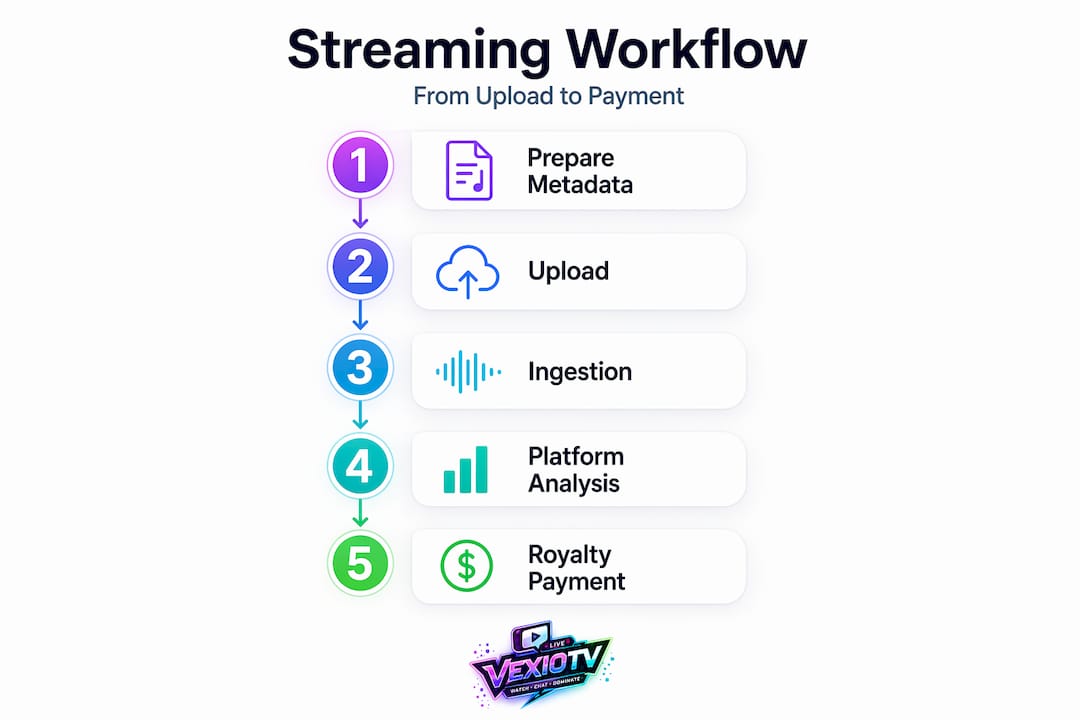
One thing many creators do not realize: inconsistent metadata across platforms creates fragmentation. If your track appears under slightly different artist names on two platforms, streaming data does not aggregate properly. This affects your total stream count, your chart eligibility, and your royalty reporting. The fix is simple: standardize your metadata before delivery and verify it on each platform post-release.
For creators who also perform live, sync your release timing with your performance streaming guide strategy. Releasing a track the week of a scheduled livestream creates a natural promotional loop: your live audience discovers the new track, streams it, and that activity feeds back into the algorithm.
Monetization and royalty distribution explained
Once your track is live, understanding how your plays turn into actual payouts is essential.

Streaming platforms operate on a pro-rata model. Streaming uses a pro-rata model: platforms pool 65 to 70 percent of their total revenue from subscriptions and advertising, then distribute that pool based on each track's share of total platform streams. If your tracks represent 0.001% of all streams on a platform in a given month, you receive 0.001% of the pool.
What this means in practice:
- Independent artists with smaller audiences earn less per stream than major label artists, because large catalogs dominate the stream count
- Your per-stream rate is not fixed. It fluctuates monthly based on the total pool size and total streams platform-wide
- A larger total pool does not automatically mean higher per-stream rates if total streams also increase
"Spotify's 2023 royalty pool reached $9.1 billion from $12.9 billion in total revenue. Yet viral tracks still stress transcoding infrastructure, accounting for 35% of compute resources during peak periods."
Two main royalty types you need to track:
- Mechanical royalties: Paid for the reproduction of your composition (the song itself, not the recording). Collected by organizations like the Harry Fox Agency or through your distributor.
- Performance royalties: Paid when your recording is publicly performed or broadcast. Collected by Performing Rights Organizations (PROs) like ASCAP, BMI, or SESAC in the U.S.
If you are not registered with a PRO, you are leaving performance royalties on the table every single month.
Approximate per-stream rates by platform (2024 averages):
| Platform | Average per stream | Notes |
|---|---|---|
| Spotify | $0.003 to $0.005 | Varies by listener country |
| Apple Music | $0.007 to $0.01 | Higher per-stream average |
| Amazon Music | $0.004 to $0.007 | Prime vs. Unlimited tiers |
| Tidal | $0.007 to $0.013 | Higher for HiFi subscribers |
Metadata accuracy directly affects revenue. If your ISRC code is missing or wrong, royalty systems cannot attribute streams to you. If your songwriter credits are incomplete, mechanical royalties route incorrectly. Every field in your metadata has a financial consequence.
For a broader look at how streaming monetization for creators works across different models, and how music streaming revenue models differ by platform type, those resources provide additional context for planning your income strategy.
Optimizing for discovery and live engagement
Understanding monetization leads naturally to making your music stand out, both for new fans and during live events.
Algorithms on major platforms reward consistency, context, and engagement signals. Here is what actually moves the needle:
Actionable optimization steps:
- Release on schedule. Friday is the global release day for music. Releasing on schedule aligns you with editorial windows and platform promotional pushes.
- Use specific genre and mood tags. Broad tags like "pop" or "electronic" are competitive. Sub-genre tags like "lo-fi hip hop" or "indie folk" match you to more targeted playlists.
- Write detailed track descriptions. On platforms that allow descriptions, include relevant keywords, mood descriptors, and context about the recording.
- Engage early listeners. Streams in the first 24 to 72 hours send strong algorithmic signals. Mobilize your existing fanbase to listen immediately after release.
- Sync releases with livestream dates. If you perform on VexioTV, schedule your release the same week as a major stream. Announce the track during the live event, direct viewers to stream it, and track the spike in activity.
- Cross-promote across tracks. If a listener plays one of your songs and then plays another, it strengthens your artist profile in the recommendation engine.
Accurate metadata via distributors enhances algorithmic recommendations, and this effect compounds over time. Every correctly tagged track adds to the platform's model of who you are as an artist and which listeners you match.
Pro Tip: Time your VexioTV livestream to start within 48 hours of a new release. Ask your live audience to stream the track during or right after the broadcast. That burst of activity within the release window significantly increases the chance of algorithmic playlist consideration.
For creators looking for specific tactics, the innovative streaming strategies guide covers additional approaches to income and growth. The creative live streaming ideas resource also covers audience engagement techniques that work especially well when you are dropping new music.
What creators overlook about the music streaming process
Strategies for optimization are most powerful when paired with an honest look at what the industry conversation often gets wrong.
Most content about music streaming focuses on "how to get on playlists" or "how to grow streams." That framing misses something important. The process is not just a distribution conveyor belt. It is an information system. Every piece of data you submit either works for you or against you, and the damage from bad metadata is often invisible until you check your royalty statements months later.
Many experienced creators still submit music with incomplete publishing information. They have the audio right but skip the PRO registration. They use a distributor for Spotify and a separate deal for sync licensing, and the ISRC codes do not match. These are not beginner mistakes. They are the result of moving fast without a process in place.
The pro-rata model also creates a reality that most articles skip over. For independent or niche artists, your earnings per stream are structurally lower than for major label artists, not because your music is worth less, but because the math disadvantages small catalogs. User-centric payout models, which route a subscriber's money to the artists they actually listen to, have been tested by some platforms and produce better outcomes for independent creators. Staying informed about these shifts matters.
For content creators, understanding the process allows syncing live performances with popular tracks and algorithms on platforms like VexioTV. This is a structural advantage that purely passive streaming strategies do not have. Live performance creates immediate engagement data, and that data can amplify an otherwise slow-moving catalog release.
The creators who build sustainable streaming income are not the ones who release and wait. They treat each release as part of a broader programming schedule. They align it with artist livestream engagement events, build anticipation before the release window, and continue promoting it weeks after. That ongoing activity keeps streams coming in and keeps the algorithm's attention on their catalog.
The key takeaway: releasing a track is the start of the work, not the end of it.
Take your music streaming to the next level with VexioTV
You now have a clear picture of how the music streaming process works, from metadata prep to royalty collection and algorithmic discovery. The next step is applying it with the right platform behind you.
VexioTV gives music creators a direct path to live performance streaming, community building, and monetization in one place. You can go live with one click, sync your releases with your broadcast schedule, and build the kind of engaged audience that translates into real streaming activity. Whether you are dropping a new track or performing live covers, VexioTV is built for creators who want to connect their streaming strategy with a live presence. Sign up and start streaming today at VexioTV.
Frequently asked questions
How does the pro-rata model affect my streaming income?
Your earnings depend on your share of total streams, which can mean less revenue for smaller artists when superstars dominate streams. Pro-rata disadvantages smaller artists as superstar streams dilute the pool, though user-centric models tested by platforms like Deezer offer a more equitable alternative.
Why is metadata accuracy critical for streaming?
Incorrect metadata can lead to missing royalties and make your tracks harder to discover and recommend to new listeners. Metadata inaccuracies lead to discovery and royalty tracking failures that are difficult to correct after release.
How do platforms like Spotify analyze my music?
They analyze both your audio and your metadata to determine recommendation fit and playlist potential. Platforms analyze metadata and raw audio upon ingestion, extracting audio features like tempo, energy, and mood automatically.
What percentage of streaming revenue is paid to artists?
Typically, 65 to 70 percent of platform revenue is pooled for distribution, with average earnings per stream ranging from around $0.003 to $0.005 on most major platforms, though rates vary by platform and listener geography.