
TL;DR:
- Brand collaborations with creators now include large campaigns beyond simple sponsored streams.
- Successful collaborations require clear goals, written agreements, mutual promotion, and ongoing evaluation.
- Poorly managed partnerships can cause stress, audience misfit, and missed growth opportunities.
Streamer collaboration is not just two creators playing a game together. Brands, travel companies, and major institutions are now launching their own collaborative campaigns with creators, changing what collaboration looks like and who benefits from it. That shift matters to every streamer looking to grow. This article explains what streamer collaboration actually covers, how different formats work, what can go wrong, and how to build a plan that brings real results for your channel and your community.
Table of Contents
- Defining streamer collaboration: More than just teaming up
- How streamer collaborations work: Core formats and frameworks
- Potential pitfalls: When collaborations go wrong
- Actionable steps: Launching successful streamer collaborations
- Our perspective: Why strategic collaborations are game-changers, if done right
- Streamline your collaboration journey with VexioTV
- Frequently asked questions
Key Takeaways
| Point | Details |
|---|---|
| Collaboration is evolving | Streamer collaborations now include brands and institutions, not just fellow creators. |
| Choose formats wisely | Long-running and event-based campaigns each offer unique benefits and challenges. |
| Avoid common pitfalls | Forced partnerships and poor planning can cause stress—make expectations explicit. |
| Strategic planning matters | Setting clear goals and communication leads to effective and enjoyable collaborations. |
| Support is available | Platforms like VexioTV can help streamline collaborative streaming for creators. |
Defining streamer collaboration: More than just teaming up
Most creators think of collaboration as a co-stream or a guest appearance. That view is too narrow. Streamer collaboration now covers a wide range of arrangements, from two creators swapping audiences to large brands running full campaigns with a creator as the face of the effort.
The scope keeps growing. Creative live streaming has opened doors for musicians, travelers, chefs, and artists to partner with creators in ways that would not have made sense five years ago. Collaboration is no longer limited to gaming. It is spreading across every content category on every major platform.
A clear example is the Expedia and IShowSpeed campaign. Expedia ran a global travel series built around IShowSpeed, sending the creator to multiple countries and streaming the experience live. This was not a simple sponsor mention. It was a full co-marketing campaign structured as a series of live events. As Expedia confirmed, streamer collaboration can involve brand and institution-led co-marketing, and it can be executed as long-running or event-based livestream campaigns. That campaign reached audiences across continents and set a new standard for what brand-to-creator collaboration can deliver.
The main types of streamer collaboration include:
- Creator-to-creator co-streams: Two or more creators go live together, sharing one stream or appearing as guests in each other's channels.
- Creator swaps and raids: Creators send their audiences to each other's channels at the end of a stream.
- Brand-to-creator campaigns: A brand funds and shapes a content series with a creator, similar to the Expedia model.
- Institution-led initiatives: Organizations, charities, or media companies recruit creators to participate in structured live events.
- Cross-platform collaborations: Creators on different platforms coordinate content to share audiences without being on the same stream.
Understanding streaming platform benefits helps you see why each of these formats can produce real audience growth. Each type serves different goals and requires a different level of planning.
"Expedia's partnership with IShowSpeed shows that brand-led creator collaboration can function as a long-running campaign, not just a one-time activation." — Marketing Dive, 2024
How streamer collaborations work: Core formats and frameworks
Now that you know the different players, let's explore exactly how these collaborations are structured and executed.
Not every collaboration is built the same way. The two most common structures are event-based and long-running campaigns. Each has specific strengths depending on your goals.
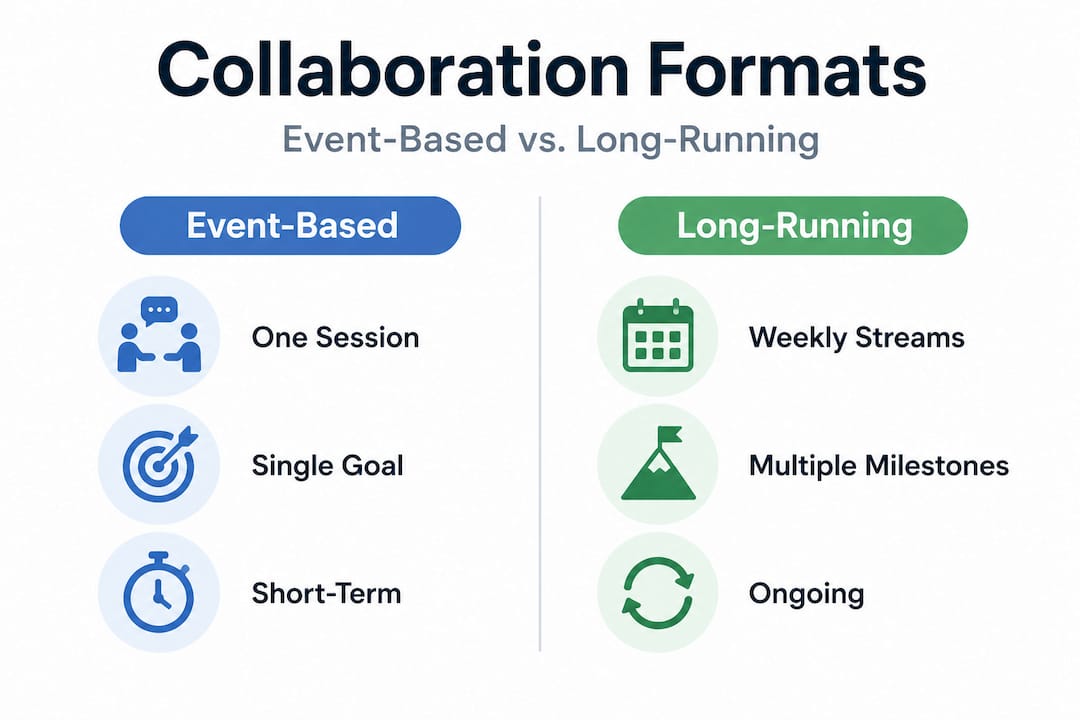
| Feature | Event-based collab | Long-running collab |
|---|---|---|
| Duration | One session or short series | Weeks or months |
| Planning needed | Low to medium | High |
| Audience impact | Immediate spike | Sustained growth |
| Best for | New partnerships, product launches | Brand deals, community building |
| Risk level | Lower | Higher if mismanaged |
| Revenue potential | Short-term boost | Ongoing earnings |
Streamer collaborations structured as campaigns can be either event-based or long-running, and each format demands a different approach to planning and execution. Knowing which format fits your situation saves time and reduces conflict later.

Brand-driven co-marketing works differently from creator cross-streaming. In a brand deal, the brand sets objectives, provides budget, and often controls the schedule. The creator provides audience access and content style. In creator-to-creator arrangements, both parties negotiate more freely, but there is also less external structure holding things together.
Here is how a typical collaboration unfolds, step by step:
- Initial contact: One party reaches out with a clear proposal outlining goals, format, and expected audience overlap.
- Alignment meeting: Both sides discuss what success looks like, who handles production, and what each party contributes.
- Terms agreement: A written or documented agreement covers content rights, revenue splits, promotion commitments, and opt-out options.
- Content planning: Both parties build a content calendar that fits their regular schedules without overloading either creator.
- Promotion phase: Both promote the upcoming collaboration to their existing audiences before the stream goes live.
- Live execution: The stream or campaign goes live with any interactive elements, overlays, or viewer calls-to-action in place.
- Post-stream review: Both parties compare metrics, gather viewer feedback, and decide whether to continue the partnership.
Following streaming best practices throughout this process makes a real difference. Technical quality matters in collaborative streams just as much as it does in solo content.
Pro Tip: Run a test stream before the official collaboration goes live. This helps both creators spot audio issues, platform conflicts, or scheduling problems before they affect a real audience.
An interactive stream setup also improves collaborative content. Polls, shared viewer challenges, and combined chat commands give the audience a reason to stay active throughout the stream rather than dropping off after the initial excitement.
Potential pitfalls: When collaborations go wrong
With collaboration formats covered, let's turn to the risks and how to avoid common mistakes.
Collaboration sounds straightforward on paper. In practice, it introduces friction that solo streaming does not. The biggest problems are not technical. They are organizational and interpersonal.
The streaming culture around collaboration has grown fast, but the norms for handling disagreements and consent have not always kept pace. That creates real problems for creators who jump into partnerships without a clear framework.
Common mistakes that cause collaborations to fail include:
- Forced team-ups: Pairing creators whose audiences have nothing in common, leading to low engagement and awkward content.
- Unclear expectations: Not agreeing on who promotes the stream, who controls the content, or what happens if one party drops out.
- Unequal effort: One creator carries the production load while the other treats the collaboration as a passive appearance.
- Ignoring audience fit: Assuming that bigger always means better, when a smaller, aligned audience delivers stronger results.
- No opt-out clause: Starting a long-running campaign without agreeing on how either party can exit if the partnership is not working.
- Skipping the debrief: Moving on after a stream without reviewing what worked, which means repeating the same mistakes.
Not all collab formats are automatically beneficial. When collaboration execution is forced or mismanaged, creators report negative experiences and stress. Explicit consent, planning, and opt-out controls matter significantly. This is an important reality. Creators who feel locked into bad partnerships often produce lower-quality content, experience burnout, and lose audience trust.
"Collaborations that lack clear communication and consent structures tend to cause stress and negative outcomes for all parties involved." — Toxigon, Twitch Collaborations Made Easy
To avoid streamer mistakes before they cost you audience members and reputation, treat every collaboration like a small business arrangement. That means written terms, clear deliverables, and an honest conversation about what happens when things do not go as planned.
Pro Tip: Before agreeing to any collaboration, ask each potential partner what their exit process looks like. A partner who has no answer to that question is a partner who has not thought the arrangement through.
Actionable steps: Launching successful streamer collaborations
Having uncovered potential pitfalls, let's shift to proven strategies for launching collaborations that thrive.
Careful planning and communication for mutual benefit are what separate successful collaborations from wasted time. The steps below give you a repeatable framework you can use for any type of collaboration, whether it is a one-time co-stream or a multi-week brand campaign.
-
Identify compatible partners. Look at audience demographics, content style, and posting frequency. Use your own analytics to find creators whose viewers overlap with yours but do not completely duplicate your audience. A 30 to 40 percent audience overlap is generally healthy without creating redundancy.
-
Set specific goals before reaching out. Know what you want from the collaboration. More subscribers, more concurrent viewers, brand awareness, or revenue? Document these goals so you can measure results later.
-
Make a clear, direct pitch. When you contact a potential partner, state what you are proposing, why it benefits them, and what you are contributing. Vague pitches waste everyone's time.
-
Negotiate terms in writing. Cover content ownership, promotion responsibilities, revenue sharing, scheduling, and what happens if one party needs to cancel. This does not need to be a formal contract, but it needs to exist in writing.
-
Define opt-out and escalation procedures. Agree on how either party can pause or end the collaboration. Include a notice period and a process for handling any disputes over content or revenue.
-
Build the content plan together. Create a shared schedule that fits both creators' existing commitments. Over-scheduling is a common cause of burnout in collaborative arrangements.
-
Launch with coordinated promotion. Both parties should promote the collaboration to their audiences at the same time. This maximizes the initial audience spike and signals to both communities that the partnership is genuine.
-
Track metrics and share results. After each stream or campaign phase, compare viewer numbers, new follows, chat activity, and revenue. Share this data with your partner and use it to refine the next session.
-
Iterate based on feedback. Ask your audience what they enjoyed and what they want more of. Do the same with your partner. The best collaborations improve over each session, not just the first one.
For creators just starting out, this live streaming guide provides the technical foundation you need before adding collaborative complexity. Getting your own setup stable first makes the collaboration smoother for both parties. For musicians and artists, livestreaming for artists offers specific strategies for collaborative content that fits performance-based channels.
Our perspective: Why strategic collaborations are game-changers, if done right
Most guides on streamer collaboration focus on the upside and move on. What they skip is the harder truth: collaboration works best when both parties come in with structured expectations, not enthusiasm alone.
There is a common assumption that a bigger collab partner always means a better outcome. That is not accurate. A creator with 500,000 followers whose audience does not care about your content category will deliver weaker results than a creator with 15,000 followers whose audience matches your content exactly. Reach without relevance is noise. Targeted, smaller collaborations often outperform massive campaigns that lack audience alignment.
The other thing most guides miss is the importance of defining what success looks like before the collaboration starts. Vague goals produce vague results. If you start a collaboration without agreeing on which metrics matter, you will have no way to evaluate whether it was worth the effort.
We have observed that the collaborations with the clearest feedback loops produce the most consistent growth. This means tracking specific numbers, sharing those numbers with your partner honestly, and adjusting the format based on real data. That process compounds over time. Each iteration improves the collaboration slightly, and those improvements add up quickly over a series of streams or a multi-week campaign.
There is also a boundary question that most creators avoid. Collaboration requires giving another creator partial influence over your content and your audience's experience. That is a real tradeoff. The solution is not to avoid collaboration. It is to set explicit boundaries at the start so both parties know where the line is.
Review the streaming growth insights that reflect what actually drives sustainable channel growth. The data consistently shows that regular, well-structured collaborations with compatible partners outperform sporadic large-scale events.
Strategic collaboration is not about doing more. It is about doing the right arrangements with the right partners under clear terms. That approach produces real, measurable growth without the stress and conflict that poorly planned collaborations generate.
Streamline your collaboration journey with VexioTV
If you are ready to elevate your collaborations, here is how VexioTV can help.
VexioTV gives creators a direct path from planning to going live. The platform is built for streamers who want to focus on their content without dealing with unnecessary technical barriers. You can go live with one click, manage community interactions in real time, and track performance without switching between multiple tools.
For creators running collaborative campaigns, VexioTV provides the infrastructure to support multi-creator events, community engagement, and monetization built into the same platform. You and your partners can coordinate streams, grow your communities together, and earn revenue from your combined audience. Explore collaborative streaming tools on VexioTV and set up your next collaboration from a platform built to support it from start to finish.
Frequently asked questions
How do streamer collaborations increase reach and engagement?
Collaborations expose each creator's content to a new audience, generating new follows, chat activity, and shared viewers. Campaigns structured as long-running or event-based streams produce sustained growth rather than a single traffic spike.
Can brands or companies initiate streamer collaborations?
Yes. Brands and institutions regularly launch co-marketing campaigns with creators, funding structured series that serve both the brand's marketing goals and the creator's audience growth objectives.
What are the main risks of streamer collaboration?
Forced or poorly managed collaborations can cause stress, burnout, and audience dissatisfaction. Clear communication, defined expectations, and explicit consent from both parties reduce these risks significantly.
What steps should creators follow to launch a successful collaboration?
Set clear goals, choose partners with compatible audiences, document all terms in writing, define opt-out procedures, and track metrics for mutual benefit after each session to improve the next one.